

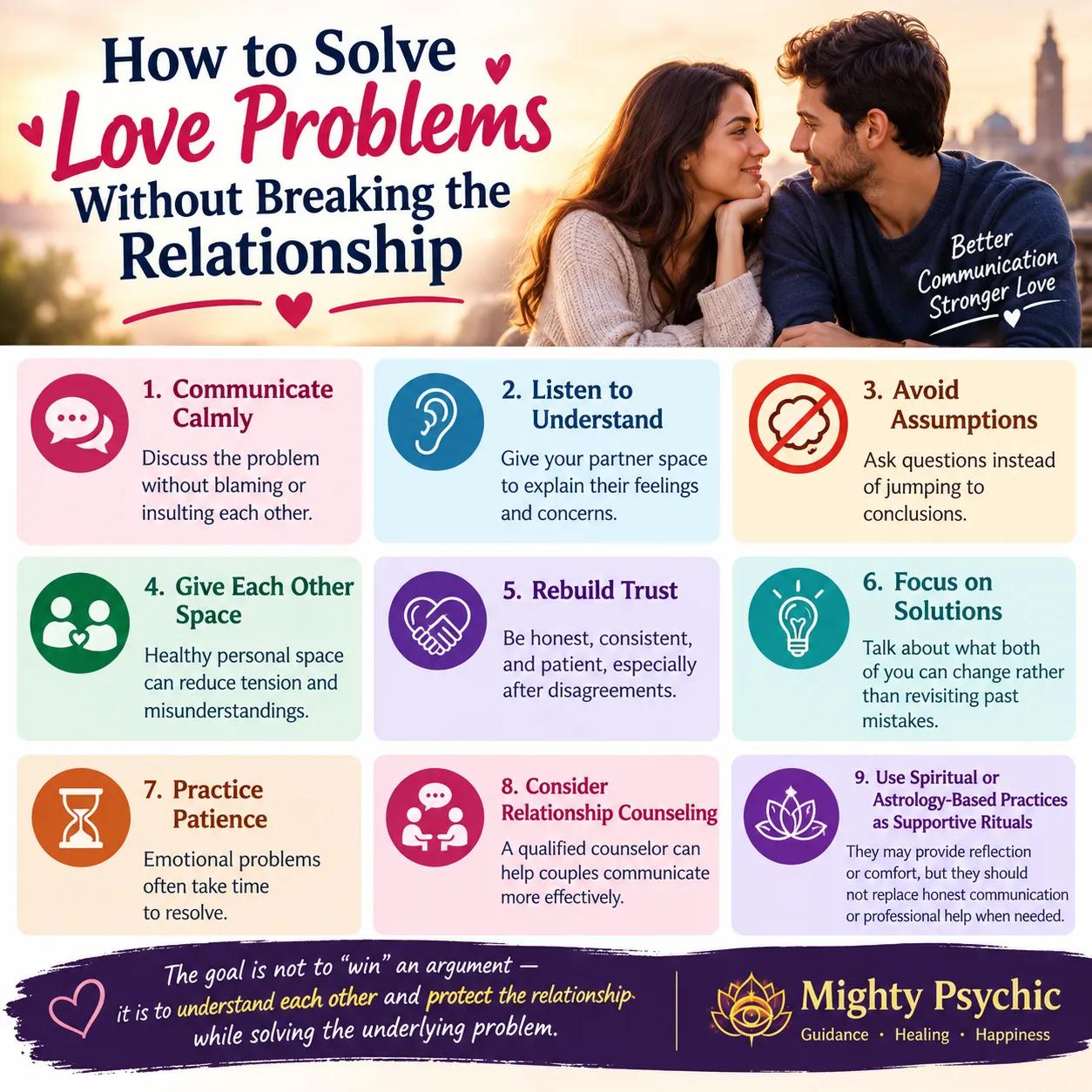
How to Solve Love Problems Without Breaking the Relationship
Learn how to solve love problems without breaking your relationship through honest communication, mutual understanding, trust, patience, emotional support, healthy boundaries, and meaningful efforts to rebuild lasting harmony. Every relationship goes through difficult phases. Misunderstandings, arguments, trust issues, communication gaps, family pressure, jealousy, and emotional distance can make couples feel that their relationship is falling apart. However, having problems does not always mean that a relationship has to end. With patience, understanding, honest communication, and consistent effort, many relationship challenges can be handled without breaking the bond. Find effective love problem solutions in London through guidance focused on communication, understanding, emotional healing, compatibility, and relationship harmony. Explore supportive approaches for resolving misunderstandings and strengthening your connection.
The key is to identify the real cause of the problem instead of reacting only to the latest argument. Whether you are dealing with frequent fights, emotional distance, insecurity, or a lack of communication, there are constructive ways to work toward a healthier relationship.

Understand the Real Cause of the Problem
Before trying to solve a relationship problem, take time to understand what is actually causing it. Sometimes the issue discussed during an argument is only a symptom of a deeper concern.
For example, a disagreement about spending time together may actually be connected to feelings of neglect or insecurity. Repeated arguments about communication may come from a lack of trust or unresolved experiences from the past.
Instead of asking, “Who is wrong?” try asking, “What is causing us to feel disconnected?”
Understanding the underlying issue can help both partners approach the situation more calmly and find a solution that addresses the real concern.
Improve Communication
Communication is one of the most important parts of a healthy relationship. When partners stop expressing their feelings openly, small misunderstandings can gradually become major problems.
Try to discuss concerns without shouting, blaming, insulting, or threatening to leave. Explain your feelings using clear and respectful language. For example, instead of saying, “You never care about me,” you could say, “I feel ignored when we do not spend enough time together.”
This small change can make a conversation less defensive and more productive.
Listening is equally important. Give your partner an opportunity to explain their feelings without immediately interrupting or preparing a counterargument. Sometimes people need to feel heard before they are ready to discuss solutions.
Avoid Making Decisions During Anger
Strong emotions can influence judgment. During an intense argument, people may say things they do not genuinely mean, including statements about ending the relationship.
If a discussion becomes too emotional, taking a short break can be healthier than continuing the argument. Both partners can take time to calm down and return to the conversation when they are able to communicate respectfully.
Taking a break does not mean avoiding the problem. It means creating enough emotional space to discuss it constructively.
Rebuild Trust Step by Step
Trust can be affected by dishonesty, broken promises, secrecy, jealousy, or past experiences. Once trust has been damaged, rebuilding it usually requires time and consistent behavior.
Promises alone may not be enough. Actions need to support those promises.
If you have made a mistake, acknowledge it honestly rather than constantly defending yourself. If your partner has made a mistake, discuss what needs to change rather than repeatedly using the past as a weapon.
Trust grows when both people demonstrate reliability, transparency, and respect over time.
Give Each Other Personal Space
Being in a relationship does not mean that two people must spend every moment together. Healthy relationships also allow individuals to maintain personal interests, friendships, responsibilities, and time for themselves.
Excessive checking, controlling behavior, or constant demands for attention can increase tension. Giving your partner reasonable personal space can help reduce emotional pressure and create a healthier balance.
At the same time, personal space should not become an excuse for emotional neglect. The goal is to create a balance between independence and connection.
Control Jealousy and Insecurity
Jealousy can become a major source of relationship conflict. Feeling insecure occasionally is normal, but repeatedly accusing a partner without evidence can damage trust.
If you feel jealous, try to understand what triggered the emotion. Is it something your partner actually did, or is it connected to previous experiences or fears?
Talk openly about your concerns rather than using accusations. Both partners can also discuss reasonable boundaries around friendships, social media, communication, and other situations that may create discomfort.
Spend Quality Time Together
Relationships need positive experiences, not only problem-solving conversations. When most interactions become arguments, couples may gradually associate each other with stress.
Make time for simple activities that both partners enjoy. This could include having dinner together, taking a walk, watching a movie, traveling, cooking, or simply talking without distractions.
Quality time can help restore emotional connection and remind both people why the relationship matters to them.
Learn to Apologize and Forgive
A genuine apology can be powerful when someone has made a mistake. However, an apology should involve more than simply saying “sorry.”
A meaningful apology acknowledges what happened, recognizes how it affected the other person, and demonstrates a willingness to make changes.
Forgiveness is also important, but forgiveness does not mean ignoring serious problems or accepting repeated harmful behavior. Healthy forgiveness works alongside accountability and boundaries.
Set Healthy Relationship Boundaries
Boundaries help partners understand what behavior is acceptable and what is not. They can involve communication, privacy, finances, family involvement, friendships, social media, and personal space.
Healthy boundaries should be discussed mutually rather than imposed by one person.
For example, a couple may agree that disagreements should not involve insults, threats, or public humiliation. Clear expectations can prevent many conflicts from escalating.
Consider Professional Relationship Support
Sometimes couples struggle with the same problem repeatedly despite trying to resolve it themselves. In such situations, speaking with a qualified relationship counselor or therapist can provide an outside perspective.
Professional support can help couples communicate more effectively, identify unhealthy patterns, and develop practical strategies for handling disagreements.
Seeking help does not necessarily mean that a relationship is failing. For some couples, it can provide a structured environment for understanding each other.
Use Astrology as a Reflective Practice
Some people turn to astrology when they experience relationship difficulties. Astrology may be used as a spiritual or reflective practice to explore themes such as communication, emotional compatibility, personal patterns, and relationship concerns.
Traditional astrological practices may include meditation, prayers, mantras, charitable activities, or other culturally meaningful rituals. These practices should be viewed as complementary rather than as substitutes for honest communication, personal responsibility, or professional support when needed.
If spiritual practices help you feel calmer and more focused, they can become part of a broader approach to relationship healing.
Know When a Relationship Needs Serious Attention
Solving relationship problems does not mean staying in a relationship regardless of circumstances. Respect, safety, and personal boundaries are essential.
Repeated abuse, intimidation, threats, coercion, or controlling behavior should not be dismissed as ordinary relationship problems. In such circumstances, seeking appropriate professional, legal, or support services may be more important than trying to preserve the relationship at any cost.
A healthy relationship requires mutual respect and the freedom to make personal choices without fear.
Final Thoughts
Love problems can be painful, but every disagreement does not have to lead to a breakup. Many couples can improve their relationship by communicating honestly, listening carefully, rebuilding trust, managing jealousy, respecting boundaries, spending meaningful time together, and taking responsibility for their actions.
The most important goal is not to “win” an argument but to understand each other and find healthier ways to move forward. Patience and consistent effort can make a significant difference when both partners genuinely want to improve the relationship.
If relationship challenges continue despite sincere efforts, professional guidance can provide additional support. Spiritual or astrological practices may also be incorporated as personal reflective tools, provided they complement—not replace—practical communication and responsible decision-making.
A strong relationship is not one without problems. It is one in which both people are willing to address problems with honesty, respect, patience, and care.